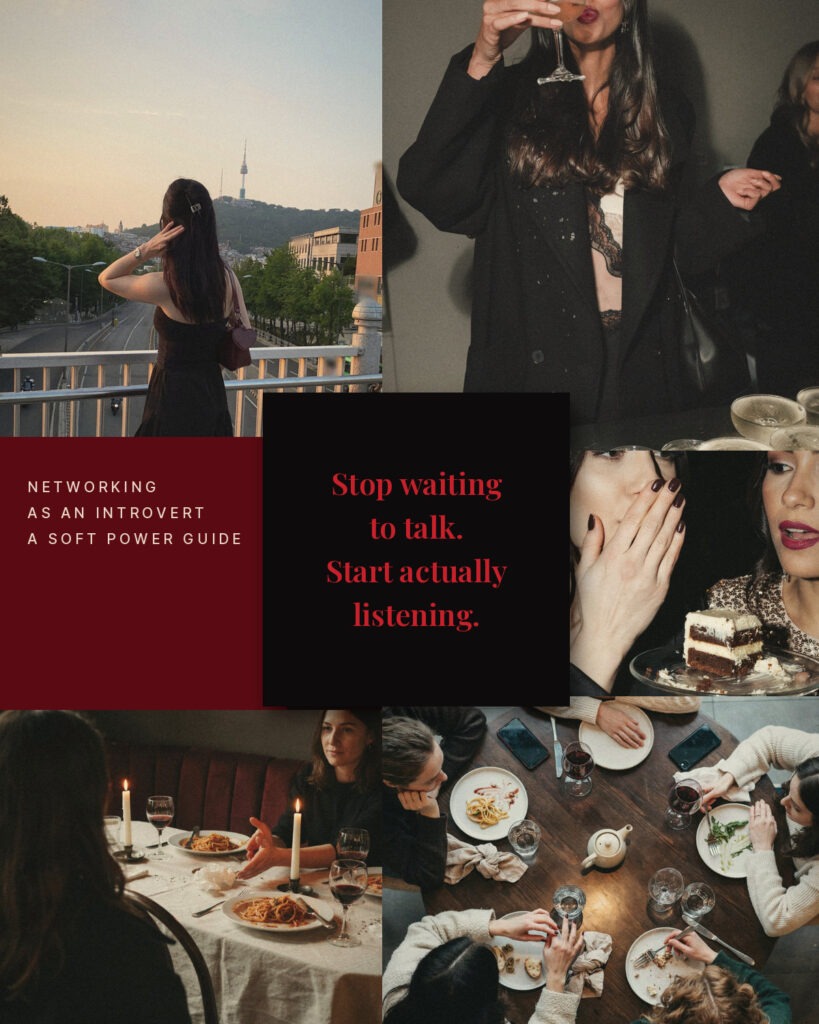
Why does social networking feel so easy for some women and so draining for others, even when everyone is standing in the same room holding the same glass of wine?
It is autumn 2026 and event season is back: launches, dinners, gallery nights, “come say hi” invitations that arrive every week. You see her laughing with three people at once, switching between conversations like it costs her nothing. Meanwhile you hover near the snack table, check your phone and wonder how long you need to stay before leaving looks acceptable.
If you want to be better at socializing and you feel like:
- you wait for someone to come and talk to you first
- small talk drains you within ten minutes
- you leave events with zero real connections
- you have been called “the shy one” for as long as you can remember
then the problem is not that you are bad with people. It is that nobody gave you the quiet version of the tools.
The tools that work best for introverts are softer than the loud networking advice we usually see, and honestly more powerful. I learned them the hard way, in a city where I did not know a single person.
Quick answer: how can an introvert get better at social networking?
Introverts do best at social networking by approaching people first, asking questions and listening more than they talk. The goal is a few real conversations, not a full room.
- Approach instead of waiting, so the other person does most of the talking.
- Ask open questions like “What good thing happened to you today?”
- Remember that most people feel lonely, and help them feel connected.
- Set a time limit, send a follow-up within 48 hours and plan time to recharge.

I moved here alone, without knowing a single person.
I knew I would make friends. I also knew it would take time.
What did my first networking event in Seoul teach me?
My first networking event taught me that connecting with people is a skill you can learn, not a personality you are born with. I was incredibly nervous before it. It was last year, in Seoul, after I had moved to South Korea on my own without knowing anyone.
I would not say I was scared, because I knew I would be able to make friends. But obviously, it would take time, and I would have to put myself out there. So I did. I went to event after event, met so many different people and connected with more of them than I ever expected.
Growing up, I was labeled the shy, introverted child. As an adult, I did not want to carry that label with me anymore. And since small talk is such an important part of making those first connections, I made a decision: if I do not like it, I will learn how to do it well.

I hate small talk. I love people.
Both are true. The right people, of course.
Are you an introvert or an extrovert, or maybe neither?
Most people are not purely introverts or extroverts, and the label matters less than your communication skills. After all those events in Seoul, I started questioning the two boxes I had always believed in. It is hard to squeeze anyone into just one of them.
Introversion vs shyness: introversion describes where you get your energy, usually from quieter settings. Shyness is fear of being judged in social situations. You can be one without the other.
Research backs up the in-between. In a 2013 study in Psychological Science, organizational psychologist Adam Grant found that “ambiverts”, people who sit between introversion and extroversion, brought in more sales revenue than either extreme.
My personal theory is that many extroverts seem more extroverted simply because they have had more practice communicating with people. I do not really consider myself an introvert. At the same time, I cannot connect with everyone easily. I do not like small talk at all, and yet I absolutely love being around people and connecting with them.
Where do you sit on the social scale?
Five questions. Get your networking style and three tips that fit it.

It promised to teach me how to connect with people.
Honestly, it did.
Which book taught me how to connect with people?
Dave Kerpen’s The Art of People is the book that changed how I approach social networking. Before I moved, I watched a YouTube video by Wizardsly that recommended it. I bought it right away, and then it sat on my shelf for a very long time.
Only after I started going to all these events in Seoul did I finally open it. The book promised to teach me how to connect with people, and it really did. Three of its lessons made social networking feel natural for me, even as the girl who used to hide near the snack table.

Most people feel lonely.
Help them feel connected, and they will never forget you.
Why should you help people feel connected?
Most people feel lonely, even when they look confident, so making someone feel included is the fastest way to build a real social connection. This idea from Kerpen changed how I walk into every room. That woman laughing with three people at once might feel just as unsure as you.
It is not only a feeling. In 2023, U.S. Surgeon General Vivek Murthy issued an advisory on loneliness, reporting that about half of American adults say they have experienced it.
Once you understand this, networking stops being about impressing people and becomes about helping them feel connected. That is a much softer, kinder goal, and one introverts are often naturally good at, because we tend to notice how other people feel.
- 1Look for the person standing alone. Walk over first. They will be relieved.
- 2Introduce two people who would get along. You become the connector without carrying the conversation.
- 3Remember names and use them. It is a small detail that makes people feel seen.

Stop waiting to talk.
Start actually listening.
Why should you stop waiting to talk and start listening?
People love talking about themselves, which is good news for anyone who finds conversations tiring: you do not have to carry them. The first step to understanding people is listening to them, to understand why someone thinks the way they do, or why they act the way they do.
Science agrees. Harvard neuroscientists Diana Tamir and Jason Mitchell found in 2012 that talking about ourselves activates the brain’s reward system, and that roughly 30 to 40 percent of everyday speech is about our own experiences. In their experiments, people even gave up small amounts of money to talk about themselves.
The mistake most introverts make
Here is a pattern I see all the time, and I used to do it too. You walk into a room full of people and wait for someone to approach you. It feels safer. It feels polite.
But if you are the one being approached, you will usually end up doing most of the talking. They ask the questions, you answer, and suddenly you are explaining your whole life story to a stranger. That is the exact opposite of what makes socializing easier.
Waiting or approaching?
Same event, two strategies. Switch and compare.
How can you be better at socializing?
To be better at socializing, ask more questions: the more you ask, the less you have to talk about yourself, and the more people like you. Instead of waiting, walk up to someone and ask how they are doing. Or, if that feels too ordinary, ask what good thing has happened to them today. It is unexpected, it makes people smile and it gets them talking about something they enjoy.
Questions also make you more likable. In a 2017 Harvard study led by Karen Huang, people who asked more questions, especially follow-up questions, were rated as more likable by their conversation partners.
Give the other person space to share. Follow up on what they say. And at the end of the night, they will probably remember you as someone they had a really great conversation with, even if you barely talked about yourself. That is the whole point. Flip the cards for openers that skip the weather.
Tap or click a card to flip it
Introvert networking: myth or truth?
Seven things people believe about socializing. Decide which ones hold up.

Who you are online is who you are in life.
The connection continues long after the room empties.
Why does who you are online matter for networking?
People often look you up before or after they meet you, so your online self should feel like the woman they just talked to. Kerpen puts it simply: who you are online is who you are in life. If your profile feels completely different from you in person, it creates confusion instead of connection.
This is great news for introverts. Social networking does not only happen at events. A thoughtful comment, a genuine message after you meet someone or a profile that reflects who you really are all continue the connection. For many of us, that quieter, written follow-up is exactly where we shine.
If your profile does not feel like you yet, start with my guide on building a personal brand online without feeling fake.
Write your follow-up message
Three details from the conversation turn into a short, warm message you can send tonight.
Next stepNothing is saved or sent. Copy it into your messages.
What is a soft power networking plan for introverts?
Soft power is influence without force: listening well, remembering details and making people feel seen. A simple plan for before, during and after an event lets you use it without running out of energy. Start by sizing the event to your social battery.
Plan the event for your social battery
Pick the type of event and how long it lasts.
Before, during and after
Tick off each step. Your progress is saved only in this browser.

One conversation is a start.
A table of friends is built one small moment at a time.
How do you build social connection that lasts?
Real social connection grows through small, repeated moments: a check-in message, a coffee, sharing something you think they would like. One great conversation is a beginning, but friendships and professional relationships are built over time.
When I moved to Seoul alone, I did not build my circle in one night. It took many events, many questions and a lot of listening. But it worked, and it worked without me pretending to be louder than I am.
Social networking does not require a louder version of you
You do not need to become an extrovert to be good at social networking. You need curiosity, a few good questions and the courage to approach people first. Remember that most people feel lonely, listen more than you talk and let your online self reflect the woman you really are.
Your quiet energy is not a weakness in a room full of people. Used well, it is your soft power.
Networking as an introvert FAQ
How do introverts network successfully?
Introverts network best with a plan: a time limit, a few prepared questions and a short list of people to meet. Approaching others first and asking questions keeps the focus off yourself. A thoughtful follow-up message within 48 hours often matters more than the event itself.
How can I be better at socializing?
Ask more questions and listen fully to the answers. People enjoy talking about themselves, and research from Harvard shows that asking follow-up questions makes people like you more. Practice approaching people instead of waiting to be approached.
What should I say at a networking event?
Skip the weather and ask something that invites a real story, like “What good thing happened to you today?” or “What are you most excited about right now?” Follow up on their answer to keep the conversation going.
How do I build social connection as an adult?
Social connection grows through small, repeated moments rather than one big meeting. Attend events regularly, follow up with people you enjoyed talking to and suggest a coffee or a second meeting. Consistency turns acquaintances into real relationships.
Is being introverted the same as being shy?
No. Introversion describes where you get your energy, usually from quieter settings, while shyness is fear of being judged socially. Many introverts are not shy, and many people sit somewhere between introversion and extroversion.
What is soft power in networking?
Soft power in networking means influencing people without force: listening well, remembering details, including others and making people feel seen. It suits introverts because it relies on attention and warmth rather than volume.
Keep going
Magnetism 12 Femme Fatale Traits That Instantly Make You Magnetic → This season Fall Main Character Energy: Your Guide to Becoming Her →Follow along
More confidence and connection inspiration on Pinterest
Conversation starters, soft power habits and evening rituals, saved in one place.
Nervous about an upcoming event? Write to me at info@opulentfemme.com