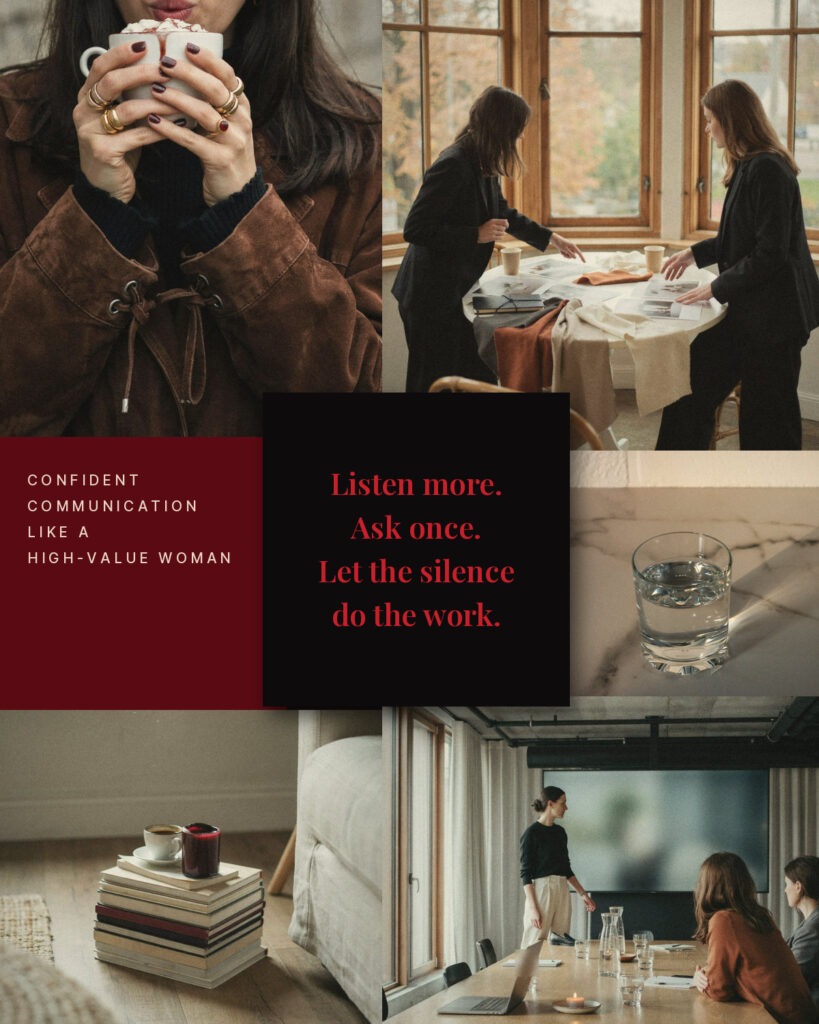
Have you ever walked out of a meeting, a salary talk or a dinner with friends replaying every sentence and wishing you had shown more confident communication in the moment?
It is autumn 2026, review season is coming, and everyone on your feed seems to know exactly what to say. “Ask for what you’re worth.” “Negotiate like a high-value woman.” Then you sit across the table from someone, and your carefully planned sentence comes out softer, longer and wrapped in three apologies.
If you want to communicate with more confidence and you feel like:
- you say “sorry” before asking a simple question
- you explain your request three times because the silence feels unbearable
- you agree to things just to end the awkward moment faster
- you only think of the right answer on the way home
then the problem is not that you lack confidence. It is that nobody taught you the technique.
Many of us grew up being praised for being agreeable. Nice girls do not interrupt. Good girls do not ask for more. So when it is finally time to ask for a raise, a better price or a clear boundary, the nervous system reads it as danger and the words shrink.
Quick answer: what is confident communication?
Confident communication means saying what you mean clearly, once, and calmly, while listening more than you speak. For negotiating like a high-value woman, it comes down to a few learnable habits.
- Listen fully instead of waiting for your turn to talk.
- Accept the glass of water, and open with curiosity, not with your request.
- State your ask in one sentence, without softeners like “just” or “sorry”.
- Stay quiet after you ask, and know your walk-away point before you start.
What does confident communication actually look like?
Confident communication is clear, short and calm: you say your point once and let the other person respond. It has very little to do with volume. A woman who can sit in silence, nod and let someone finish usually reads as more secure than the person who talks the most.
Confident communication: expressing your needs, opinions and boundaries directly and respectfully, without over-explaining, apologizing for asking or needing the other person’s approval first.
The gap is real, and it costs money. Economist Linda Babcock studied master’s graduates of Carnegie Mellon University and found that about 57 percent of the men negotiated their first salary offer, compared with only 7 percent of the women. She wrote about it with Sara Laschever in the 2003 book Women Don’t Ask.
So confident communication is a practical skill with a price tag attached, not a personality trait you either have or lack.

You knew what to say. It just came out smaller.
The words were there. The calm was not, yet.
Why does confident communication feel so hard?
Confident communication feels hard because asking for something directly can feel risky, especially if you were praised for being easy and agreeable. That fear shows up in the same predictable ways for almost everyone.
- 1Over-explaining. You justify your request so many times that it starts to sound like you doubt it yourself.
- 2Softening every sentence. “Just”, “maybe”, “I think” and “sorry” quietly shrink what you say.
- 3Rushing to fill silence. You end up negotiating against yourself before the other person even answers.
- 4Treating it like a test. You walk in hoping for approval instead of walking in as an equal.
Confident communication starts with a mindset shift. A high-value woman does not enter a conversation hoping to be liked. She enters curious about the other person and clear about her own worth. Everything else is technique.
Isn’t negotiating just being pushy?
Some women avoid negotiating because they believe it is aggressive or greedy. They would rather accept less than risk seeming difficult. That instinct comes from a kind place, but it often costs real money, time and self-respect.
Good negotiation works more like a conversation where both people try to understand what the other needs. The best negotiators are often the most generous listeners, which is exactly why this skill fits so naturally with feminine energy.
What is your communication style?
Five quick questions. Answer the way you actually react, not the way you wish you did.

It sat on my shelf for a long time.
When I finally read it, the most powerful ideas were the simplest ones.
Which book changed how I talk to people?
Most of what I know about connecting with people came from Dave Kerpen’s book The Art of People. I first heard about it in a YouTube video, bought it, and then let it sit on my shelf for a long time. When I finally read it, I was surprised by how simple the strongest lessons were.
Kerpen’s core message is that people skills, more than talent or luck, are what open doors. Three of his lessons translate perfectly into confident communication and negotiation, and they changed the way I speak, ask and listen.
Why should you stop waiting to talk and start actually listening?
Real listening gives you the information you need to negotiate well, and it makes you look calmer while you do it. In most conversations we are not listening at all. We are waiting for our turn, rehearsing the next line and half-ignoring the other person.
In a negotiation, that habit is expensive. When you truly listen, you hear what the other person actually cares about. Maybe your manager is worried about budget timing, not your value. Maybe the client cares more about speed than price. Those details give you room to propose something that works for both of you.
How to practice it
- 1Pause before you answer. Two or three seconds feels endless to you and thoughtful to them.
- 2Repeat back the key point. “So the main concern is the timeline, right?” shows you heard them and buys you thinking time.
- 3Ask one more question than feels natural. The best information usually comes after the second question.
Practice the three-second pause
Press and hold the circle until it closes. That is how long a confident pause actually lasts.
Imagine you have just been asked a hard question. Instead of rushing, hold.
0 calm pauses

Always accept the glass of water.
It sounds tiny. It changes the temperature of the whole room.
Why should you always accept the glass of water?
Accepting a drink puts the other person at ease and gives you a moment to settle before the real conversation starts. This is one of my favorite ideas from Kerpen’s book. When someone offers you water, coffee or tea before a meeting, say yes.
The person offering gets to feel like a good host, which warms them up. You get a small pause to arrive in the room instead of rushing straight into business. Many of us refuse out of politeness, as if accepting would be an inconvenience. In reality, it is a small act of trust.
High-value women know how to receive graciously. If you can accept a glass of water without apologizing, you will find it easier to accept a better deal too.

Open with what you can give.
The question people remember is rarely about you.
What is the most important question to ask in a first meeting?
Kerpen argues that the most powerful question in a first meeting is a simple one: “How can I help you?” It flips the energy of the conversation. Instead of walking in focused on what you can get, you open with what you can give.
People rarely hear that question, so they remember the person who asked it. And once you understand what someone needs, it becomes much easier to shape an offer they will say yes to. In a negotiation, this question works as strategy: you collect information, build goodwill and position yourself as a partner rather than an opponent.
Kerpen also suggests skipping small talk for deeper openers, such as asking what the most exciting thing someone is working on right now is. Draw a few below and pick the ones that sound like you.
Draw a first-meeting question
Better than “So, what do you do?”
Tap the button to draw your first question.

Say it once. Then let the room answer.
Calm is the loudest thing in a meeting.
What are the good communication skills every high-value woman uses?
Good communication skills come down to five habits: one clear sentence, no softeners, comfortable silence, calm body language and a known walk-away point. Each one is small. Together they change how seriously you are taken.
Say it once, clearly
Make your request in one sentence and then stop talking. “I’d like my salary to reflect my new responsibilities, so I’m asking for a ten percent increase.” No extra justification, no nervous laughter. Let them respond.
Saying your number first also helps you. Social psychologists Adam Galinsky and Thomas Mussweiler showed in 2001 that first offers act as anchors in negotiations, pulling the final result toward the number that was named first.
Drop the softeners
Words like “just”, “sorry”, “maybe” and “I think” quietly weaken your message. Replace “I just wanted to ask if maybe” with “I’d like to ask.” Try the rewriter below and watch how much shorter confident communication is.
The over-explaining rewriter
Choose a situation and see the same message without the apologies.
Get comfortable with silence
Silence after a request is the other person thinking, not a rejection. If you rush to fill it, you often end up negotiating against yourself. The pause practice above is the training for exactly this moment.
Use calm body language
Uncross your arms, keep your shoulders relaxed and hold eye contact for a beat longer than usual. Your body tells the other person whether you believe what you are saying.
Know your walk-away point
Before any negotiation, decide what you will accept and what you will not. Confidence comes easily when you know you are allowed to leave.
How can you improve communication skills in everyday life?
The fastest way to improve communication skills is through small, low-stakes moments every day, long before the big conversation arrives. If your café order is wrong, ask for it to be fixed without apologizing. Share your real opinion on where to eat instead of saying “I don’t mind.” Speak once in every meeting, even if it is just a question.
Each tiny moment builds the muscle. When the salary talk comes, your confident communication will feel familiar instead of forced. Here is a seven-day plan with one habit a day.
The 7-day confident communication challenge
Tap a day to see the habit, then mark it done. Saved only in this browser.
How do you negotiate like a high-value woman?
You negotiate like a high-value woman by preparing your number and walk-away point, opening with curiosity, asking once and letting silence do the work. Before your next important conversation, fill in the planner below. It turns your answers into a short script you can read on the way there.
Build your negotiation script
Four short answers. Your notes are saved only in this browser.
Confident communication is about clarity, not hardness
Confident communication asks you to become clearer, not harder. The calmer and more curious you are, the more power you carry into any room, whether it is a salary talk, a client call or a conversation with someone you love.
Accept the water. Ask how you can help. Listen more than you talk. Then say what you want once, and let the silence work for you.
Confident communication FAQ
What is confident communication?
Confident communication means expressing your needs, opinions and boundaries clearly and respectfully, without over-explaining or apologizing for asking. In practice, it means saying your point once, listening fully and staying calm in silence.
How can I improve my communication skills?
Practice in small daily moments: speak once in every meeting, share your real opinion and remove unnecessary explanations from your messages. Focus on listening fully before you respond. Consistent small practice builds confidence faster than any single course.
What are good communication skills?
Good communication skills include active listening, stating your point clearly and briefly, staying comfortable with silence, using open body language and asking thoughtful questions. Together they make people feel heard and take you seriously.
How do you negotiate confidently as a woman?
Prepare your number and your walk-away point in advance. Open with curiosity, listen to what the other person needs, then make your request once without softeners. Research on anchoring suggests naming your number first can pull the final result toward it.
What is the most important question to ask in a first meeting?
In The Art of People, Dave Kerpen suggests “How can I help you?” as the most powerful first-meeting question. It shifts the focus to giving, builds goodwill quickly and reveals what the other person actually needs.
Why should you accept a glass of water in a meeting?
Accepting a drink lets the host feel generous and puts them at ease, and it gives you a short moment to settle in before the real conversation starts. It is a small act of trust that warms up the whole meeting.
Keep going
Reinvention How To Rebrand Yourself in 60 Days → Habits 10 High Value Habits of a High Value Woman →Follow along
More confidence and mindset inspiration on Pinterest
Communication scripts, high-value habits and quiet confidence, saved in one place.
Questions about a conversation you are preparing for? Write to me at info@opulentfemme.com